The Bourke Engine is a ported valve, two cylinder, 1 stroke cycle,
horizontally opposed piston engine which attempts to harness detonation
(the Bourke cycle)
by utilizing an ultra lean air fuel mixture of about 40 to 60:1 and extremely high compression ratios of 20:1 or more.
Conventional engines are not capable of living with detonation and ping so they progressively burn the air fuel mixture (flame front) slowly in comparison so as to avoid critical parts breakage. They
pollute the air with unburned hydrocarbons and other toxic substances due to only about 25% thermodynamic efficiency out of a possible 100% rating of which no engine has ever attained to date. This is mainly due to conventional
engines not allowing or creating enough time, pressure or heat to allow the air and fuel to completely combine to create a clean pressure charge to push the piston down in the cylinder which is attached to a connecting rod and
crankshaft creating rotary motion.
Conventional engines are also purposely designed to burn a fuel rich mixture as opposed to an air rich mixture to avoid detonation, extreme pressure and temperatures which would melt and send parts
scattering. It is also necessary to note that conventional engines use what is called fuel quenching (extra fuel to cool and keep combustion temps within specific parameters) along with a liquid cooling system that also wastes
heat energy to the atmosphere. This wasted energy is put to work by the Bourke engine more efficiently.
The Bourke engine has only 2 moving parts per 2 cylinder unit. A Piston on each end of one
connecting rod joined together by a scotch yoke assembly that shuttles back and
forth with each power stroke on either end.
One crankshaft and one triple slipper bearing
riding up and down as it rotates in one direction inside the scotch yoke
allowing the crankshaft to rotate 360° per 2 strokes of the rod yoke assembly. In
other words, for every one stroke, the crankshaft turns 180 degrees. There are
two power pulses of atleast 135 degrees per half crankshaft rotation. There are no dead strokes as with conventional 4 stroke cycle engines which yield only one power stroke per two revolutions or three dead strokes out of
4.
The original Bourke Engine comes very close to stably harnessing detonation , up to
5000 FPS, intermittently and unpredictably. But if the engine is set for lower compression ratios like, 8.5 to 12:1 then it is much more tame and runs like a normal engine should, only much more efficiently due to a slightly
longer time at TDC and a very early ignition timing advance of 45 degrees before TDC.
With the presumed
higher compression ratios promoted by Russell Bourke, I.E. 18 to 24:1 they suffer from run away phenomenon and are very uncontrollable. The key to stably harnessing detonation lies in the slightly longer dwell time at TDC. It has been found that
super high compression ratios or super lean air fuel mixtures are not needed to create stable detonation .
Conventional engines are designed to avoid and cannot
live with the powerful forces of detonation. A conventional engine is designed to harness a
mere 80 to 100 f.p.s. When this occurs in a conventional engine, it 'pings', which is the sound generated by the thrust facing of the piston rapping against the cylinder wall due to intolerable
pressures generated by detonation. The original Bourke Engine was designed to harness detonation and had ended up and a stepping stone in the quest to harness what conventional engines cannot tolerate.
Further it has a crank case that is sealed off from the cylinders keeping the
lubricating oil from being polluted or cooked which is common in
conventional engines. This means you don't have to change the oil very often if
at all but only need to add some every once in a while. The Bourke Engine can be
overhauled in minutes using only one or two tools. It is compact, light weight
and extremely durable. However, in spite of claims by Russell Bourke in his documentary, others who cannot tell the difference between low and high frequency torque pulses and vibration, it is not self balancing nor inherently vibration free. It is capable of
pressure ignition due to the extremely high compression ratios used but as of yet has not been able to burn diesel fuel very effectively because diesel fuel cannot be carburatored or premixed with air before it enters the
combustion chamber. It must be directly injected at a precise time into the combustion chamber when a certain pressure and temperature are attained. The Bourke engine is no different where the use of diesel fuel is concerned.
It is capable of very high RPM, up to 10,000 RPM's or more developing
tremendous horse power and torque for it's size. Russell Bourke claims even higher safe rpm's of up to 24 thousand! No one has been able to prove this claim to date.
The Bourke engine is proven so far to be a much more efficient 'carbon oxygen level' reaction prime mover. That is to say that just by the use of a scotch yoke mechanism , slightly longer time at TDC can be attained
allowing for slightly more complete combination of the burning air fuel mixture to take place before the piston begins to move down the cylinder.
It can be designed, as with any engine, to suit any given application. Automobiles, aircraft, boats, generators,
pumps, truck engines, racing engines, torque engines, miniature engines, off road dirt and street motorcycles etc. Virtually anything that uses a
reciprocating or small turbine engine ! All engines and motors must be designed based on a given application no matter what type of engine or motor it is. Physical fact.
The Bourke Engine ignites the air fuel mixture much earlier and holds the air fuel mixture at TDC slightly longer than conventional engines. That is one reason why the Bourke Engine can
produce much more HP per pound of fuel and a lot less pollution. Due to the way
the Bourke Engine creates all this power and torque it can turn more heat energy
into actual work and do it cleanly unlike conventional engines of
today. About 63% total efficiency has been attained vs. 23% for conventional engines.
In fact today's conventional engines are still highly inefficient and
only turn about 25% avg. heat energy into actual work wasting the rest of
the heat through the radiator and exhaust pipe! One other negative factor with conventional engines, carburatored or fuel injected, including diesel is that they use tremendous amounts of fuel to 'quench' the cylinder under heavy
loads as they would otherwise burn up or melt a hole in the piston due to lack of cooling capability with conventional liquid or air cooled engines. The Bourke Engine does not use 'fuel quenching' under any circumstances.. In fact it acts more
like an electric motor using only as much fuel as needed to produce power under any given load demands where with conventional engines of yesterday and today, they will burn nearly the same amount of fuel going down a hill as they
will going up the same grade hill based on the same throttle position. You may think, O.K. I'll just pop it in neutral on downhill's or shut down the engine when I am stopped. Nope! Ain't gonna make much difference! How much fuel
does it take to start that sucker back up? You guessed it, about the same amount of fuel is wasted! You just can't win with conventional engines. Nuh uh!
The Bourke engine is easily 50%+
efficient on any similar fuel such as no-lead regular. By the way, there is no
such thing as no-lead gasoline. Today's so called lead free fuels still contain
lead, just lower amounts of it per pound of fuel. The Bourke Engine is Multi Fuel Capable and has been found ideally suited for burning natural gas, propane, acetylene, un-doped or chemically unaltered fuels.
The Bourke Engine is proof that simplicity is the key to higher efficiency!
See a full size animation of the engine.
|
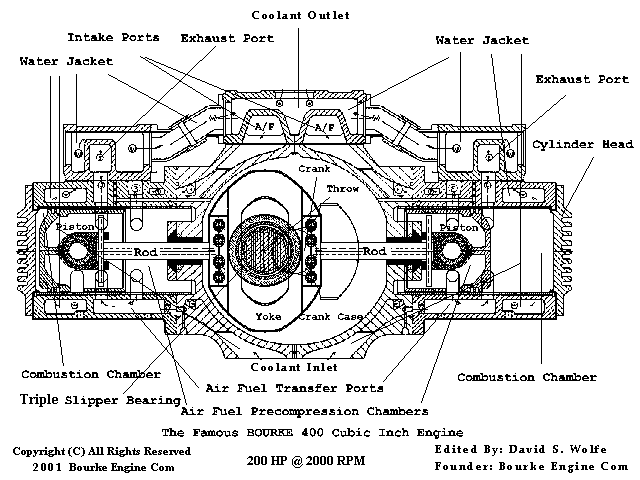
Below is a cross
sectional view of the Bourke 400 cu. in. 4 cylinder engine. Russell Bourke claimed it was capable of creating 200 HP @ 2000 RPM based on the information contained
in the Bourke Engine Documentary and the Bourke Engine Blueprint Set.
Basically the Bourke Engine comes in 2
cylinder horizontally apposed units. Each section is in itself a
separate 2 cylinder engine and can be bolted together to
attain as many multiples of 2 cylinder units as desired. 2/4/6/8/10/12
cylinder engines etc. As you will notice in the drawing below, there are
two cylinders, two pistons, two connecting rods, a 'scotch yoke'
assembly, a large throw camshaft acting as the crankshaft. One triple
layer bearing which rolls on each rod facing in the yoke assembly in a
complete 360° circle per 2 strokes of the rod/yoke assembly.
The action
of the triple layer bearing ( Russell Bourke called it a triple
slipper bearing ) as it rolls across each rod facing in the yoke has the
action similar to one kicking a soccer ball with the bottom part of ones
foot making the ball roll. Not kicking it with ones shoe tip or heel but
progressively moving the ball in a circle by using the bottom of the
foot starting at the tip of the shoe and ending with the heel making it
roll. There has been much controversy over time about the true
action of this mechanism but we have proven that it truly does roll in
only one direction, not reverse 4 times per revolution as argued by a
few so called experts. They are just plain flat wrong! We have
proven it beyond any doubt.
Further we have proven that the exhaust gas temperature (E.G.T) and exhaust
emissions (C0 & HC) are very low and in some respects non
existent as compared to conventional engines of today.
Why? Because of the direct opposed ( true linear/non angular ) movement
of the piston/rod assembly as well as the length of time at top dead
center (TDC) which is slightly greater in
the Bourke Engine than in a conventional design engines allowing for
much higher compression ratios. Also the action
of pulling the air/fuel mixture beneath the piston (pre compression
chambers) lend an extra fuel cracking process and super charging.
One thing that was discovered during research of later prototypes of the Bourke 30 cubic inch engine is that detonation is not necessarily dependant upon very high compression ratio's. Using very high compression ratio's
tend to make any engine uncontrollable and unpredictable. Where super lean air fuel mixtures and high compression ratio's will yield some interesting results, the Bourke cycle is only attainable during an extremely narrow
power band and at very high RPM's 'around 6 to 10,000' called the sweet spot the engine did become almost completely quiet and did produce quite a bit or torque but you simply cannot depend on it to be a stable reaction or
again, even predictable. Due to the chemical compositions of carbon based fuels it is necessary to use fuel cranking to produce mono fuels meaning they must not contain any substances that cause a specific burn rate. They
must be completely non-volatile meaning it will only explode or burn in the combustion chamber after the innitial cracking or atomization process that occurs under the piston as it is being transferred to the top of
the cylinder. This makes for a very impractical situation.
The actual truth of the matter is that very high compression ratio's and super lean air fuel mixtures are not needed 'or desired' in order to get the Bourke engine to produce lots of torque and horse power
with extremely low or no harmful emissions. The key is in FACT 'INCREASED TIME AT TOP DEAD CENTER' ! This is the phenomenon Russell was unknowingly examining but he became convinced 'of not deluded' into thinking his design
and ideas were final and no one could tell or convince him otherwise. This is one of the key reasons the man sabotaged himself and his dreams of winning millions of dollars in rewards for his efforts. Basically Russell
goofed! He did a Homer Simpson DOH! on that for sure ;-).
All Russell would have needed to do is lower the compression ratio's and find a way to dwell the pistons a little bit longer at top dead center. Then his work would have been truly complete and easily
duplicatable. He simply could have patented and registered his findings and licensed his formula's to the major engine manufacturers and been known for eternity as the guy who figured out how to make piston engines what they
were always intended to be. It is interesting to note that at lower RPM's the Bourke engine will burn many different kinds of fuels much more efficiently than conventional engines even though it is not complete. Maybe I will
complete that work on the original engine but it will require some modifications to the scotch yoke mechanism. Modifications that are very simple and only require a bit of fancy and tricky machine grinding on the shoe of the
connecting rods. You'd never believe just how simple it is!
There are other ways to increase piston dwell though. Totally different types of crankshafts or cams can and have been designed. I invite you to use your imagination. Study the other engines I mention
below. It's so darn easy it's funny! The best way to start figuring it all out is to purchase and read The Bourke Engine Documentary. That is how we all got started. It is
indeed a very interesting adventure and believe me you will never think the same way about piston engines after you read it. It is a real eye opener!
Increased time at top dead center 'longer piston dwell time' is all that is needed in any engine
to make it as much as 80% more efficient and powerful! That's it! You can find conclusive evidence of this by looking at the CMC engine or the DeVaux engine created by Melvin Vaux who worked with Russell for a few years
way back in the early 50's when he was a young man. The RADCAM engine is also currently under development, invented by Mark Beierle, and others like the Quasi Turbine engine and a host of other cam types which you can find
by searching the web.
Keep in mind. Russell Bourke was indeed an extremely ingenious man. He did after all start the ball rolling by proving that DETONATION can be harnessed and controlled although he was not exactly correct
in how to attain a stable and controllable mode of operation. In my opinion had Russell been a bit more open to Melvin's thoughts and abilities, Russell would have succeeded beyond his wildest dreams and the Documentary
would have had a much happier ending. On top of that we all would have probably been using his technology for decades now and not wasted billions of gallons of carbon based fuels and polluted our atmosphere with green house
gasses. This planet 'as Russell envisioned' would be a lot cleaner and greener today!
Have a look at the cross sectional cut away
diagram below.
|
See a full size animation of the engine!
Copyright © 1998-2003 Bourke Engine Com LLC All
Rights Reserved